
Acroview technology
Power Delivery Test Requirements for High-Current AI Compute
AI compute hardware is entering a higher-power operating regime. In 2026, GPUs based on the NVIDIA Vera Rubin architecture are reaching power levels of up to 3,700 W, more than five times that of the H100. As power density continues to increase, liquid cooling is moving from an optional approach toward a requirement for high-density compute clusters.
At these power levels, stable power delivery, operation under extreme conditions, and long-term reliability are becoming increasingly important to AI infrastructure. These hardware characteristics place greater demands on the testing of high-current power devices, particularly where electrical and thermal conditions must be controlled throughout production.

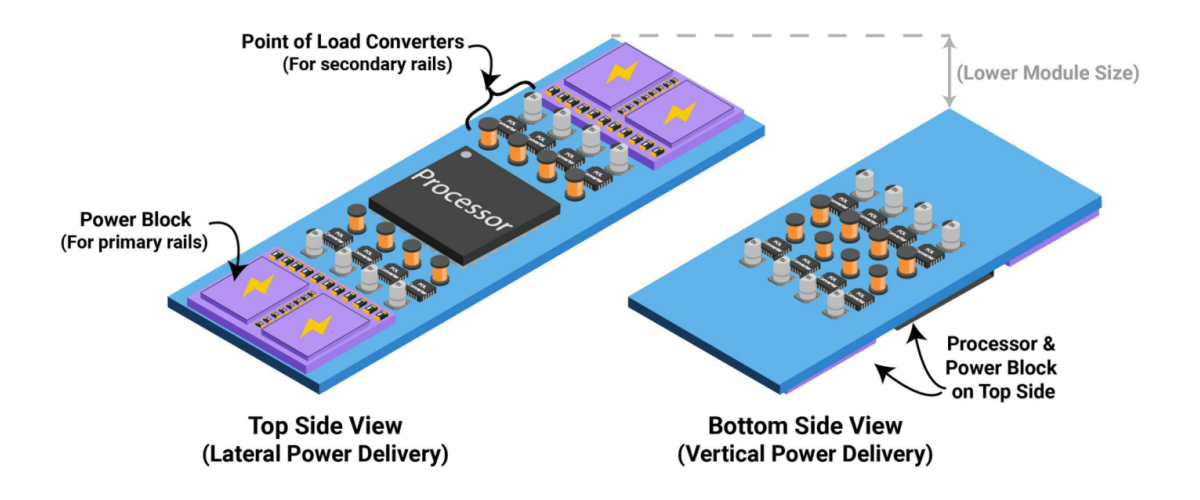
As large language models move toward the ten-trillion-parameter range, GPU current requirements are reaching the kiloampere level. Conventional Lateral Power Delivery (LPD), which routes power laterally across the PCB around the GPU, is facing increasing physical constraints at these current levels. NVIDIA, Intel, Google, and other major industry players are investing in Vertical Power Delivery (VPD) as an alternative architecture for next-generation high-performance computing.
Limitations of Lateral Power Delivery
In a conventional LPD architecture, power modules are arranged around the GPU, with current routed laterally through copper traces on the PCB surface. This approach is increasingly difficult to scale as GPU operating voltage decreases while current requirements continue to rise.
Three limitations are particularly relevant.
Higher conduction loss and thermal load.
At kiloampere-level current, resistance along the power path results in increased I²R loss and voltage drop. The associated heat adds to the thermal load and can contribute to component aging during sustained operation.
Longer current paths and transient response.
Lateral routing increases the length of the power delivery path and introduces parasitic effects that affect transient response. This becomes more challenging as AI workloads place rapidly changing demands on the power delivery network.
Limited space around the GPU.
The area surrounding the GPU is increasingly occupied by HBM memory, leaving less room for conventional power modules. This limits the available space for further expansion of the LPD architecture.
VPD Architecture and Its Implications
VPD changes the physical arrangement of the power delivery network. Voltage regulator modules (VRMs) and point-of-load (POL) regulators are positioned on the back side of the PCB, directly aligned with the GPU. Instead of routing current laterally around the GPU, the power path runs vertically through the board.
The shorter power path reduces impedance and power loss, while relocating the power modules frees space around the GPU. The VPD architecture can improve power delivery efficiency by approximately 5%. At large compute-cluster scale, this difference can have a meaningful impact on overall power consumption.
The shorter electrical path also reduces parasitic inductance and supports faster transient response, with response times reaching the microsecond range. At the same time, moving the power modules away from the GPU perimeter provides additional space for higher-density memory integration, including HBM4.
VPD is being adopted in high-performance computing architectures, including NVIDIA’s Rubin architecture. Major companies across the computing and power semiconductor industries are also investing in related technologies and intellectual property. As VPD adoption expands, the thermal and reliability requirements of the associated power devices become increasingly important.
Thermal and Reliability Challenges in VPD
While VPD addresses constraints related to power-path length and space around the GPU, it also creates a more demanding thermal configuration.
The GPU and the back-side power modules form closely located heat sources. The available installation space for the back-side modules can be less than 2 mm, while the modules cannot directly share the liquid-cooling resources available on the front side.
These conditions place the power modules under high-temperature and high-load operation for extended periods. In megawatt-scale compute clusters, the impact of a single power IC failure can extend to the associated compute node. For this reason, reliability verification under high electrical and thermal stress before volume production is an important part of VPD deployment.
Acroview V9000-ABI Auto Burn-In System
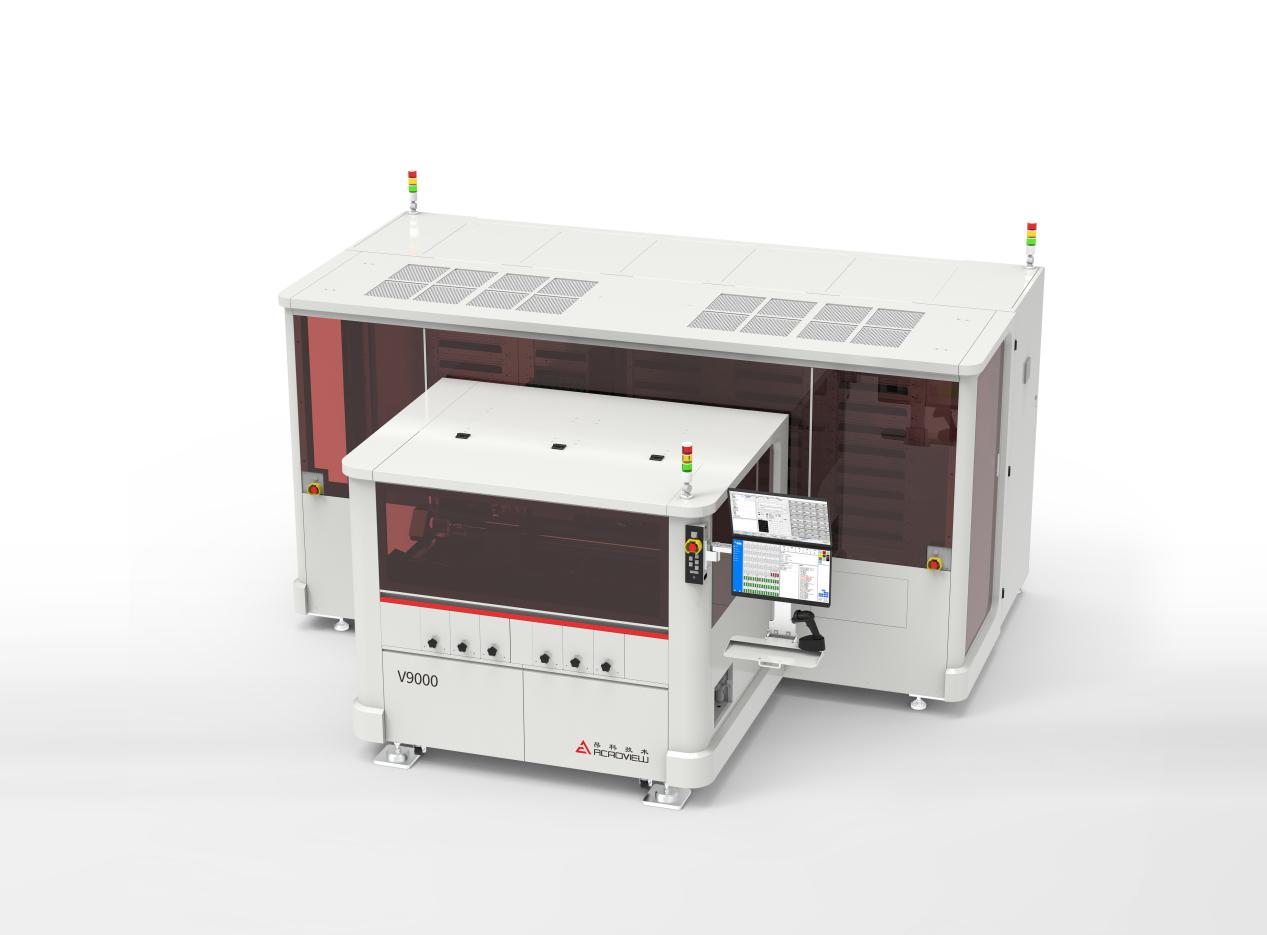
Acroview’s V9000-ABI Auto Burn-In system is developed for high-power power-module and power-IC testing, including applications in AI servers and automotive electronics.
The system uses a stacked, parallel test architecture and integrates automated loading and unloading, burn-in testing, sorting, and test-data traceability into a single production workflow.
Thermal and Electrical Test Conditions
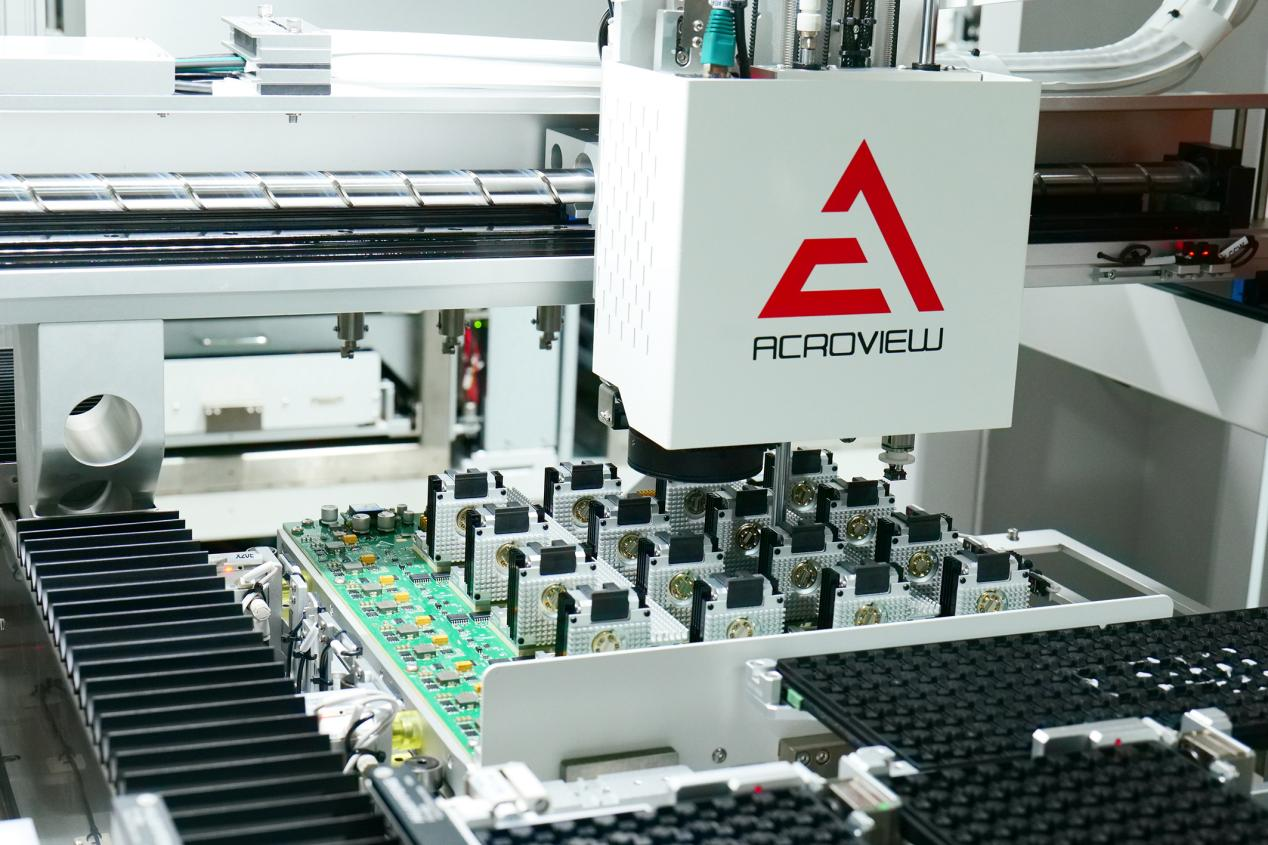
The V9000-ABI supports both air-cooled and liquid-cooled configurations. Under air cooling, the load rate can reach 50–60%. Under liquid cooling, the system supports 100% full-load operation, providing test conditions for high-load power-device applications.
Each DUT site supports independent temperature control with an accuracy of ±2°C. This allows individual test positions to be maintained under controlled thermal conditions during parallel testing and helps maintain test consistency across sites.
Power-on sequencing can be configured through software, and test data is recorded throughout the process for traceability. This provides flexibility for different power-IC specifications and application requirements.
Production Throughput and Automation
The standard configuration supports simultaneous testing of 512 DUTs and can be expanded to more than 1,000 channels.
Automated loading and unloading reduces manual handling during production. The system also incorporates high-precision pressure adjustment to help maintain consistent contact conditions during testing.
Multiple QR-code scanning functions support device traceability. Vision-based positioning is supported, with AOI inspection and laser marking available as options. These functions integrate testing, sorting, and traceability within the production workflow and support rapid changeover for high-volume manufacturing.
Energy Feedback and Maintenance
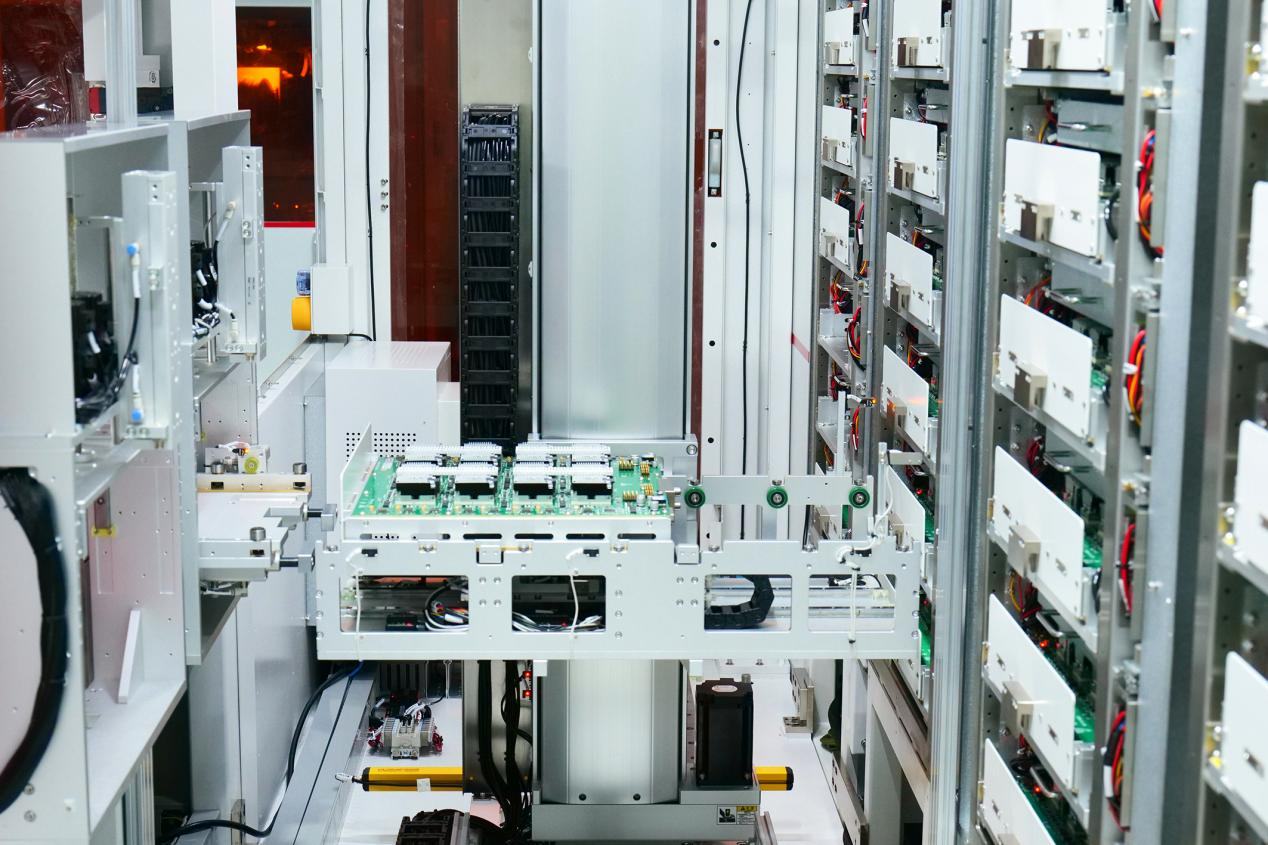
The V9000-ABI uses an energy-feedback load architecture that returns test energy to the equipment input rather than dissipating it entirely through conventional resistive loading. Compared with traditional resistive loads, this architecture can reduce energy loss by more than 90%, according to the product specification.
The socket and BIB thermal structures are designed to extend hardware service life. The modular BIB architecture also simplifies maintenance and reduces changeover requirements.
Modular Hardware Architecture
The V9000-ABI is built around a burn-in test-box architecture. Multiple test boxes can be stacked in a modular configuration to support flexible system expansion.
Each test box integrates a CCU control unit with analog and digital boards and supports configurations of up to eight boards. Digital boards handle high-speed bus communication, signal stimulus, and status acquisition. Analog boards monitor key electrical parameters and verify Pogo-pin operating conditions.
The system incorporates 16-channel source-load modules with multiple power rails, energy-feedback loading, and parameter monitoring for high-current test applications.
An ASC system provides temperature control at each test position. The motherboard/daughterboard architecture improves system compatibility, while modular high-current interfaces, zero-current separation, and automated lid operation support safe operation during high-current testing.
Production Testing for Higher-Power AI Systems
The continued increase in AI compute power is changing the requirements for both power delivery and production testing. VPD shortens the power path and relocates power modules to the back side of the PCB, while also introducing more demanding thermal conditions for those modules.
For production testing, applying higher current is only part of the requirement. Test systems must also maintain controlled electrical and thermal conditions across multiple DUTs, provide consistent site-level temperature control, support automated handling, and maintain traceable test data.
Acroview’s V9000-ABI combines high-current loading, independent temperature control, parallel burn-in, automated handling, energy feedback, and modular hardware architecture for high-power power-device testing in AI computing, automotive, and industrial electronics.

- 7F, Hanking Center (SOMA) 9968 Shennan Avenue, Nanshan Dist, Shenzhen, 518052, P.R.C
- sales@acroview.com